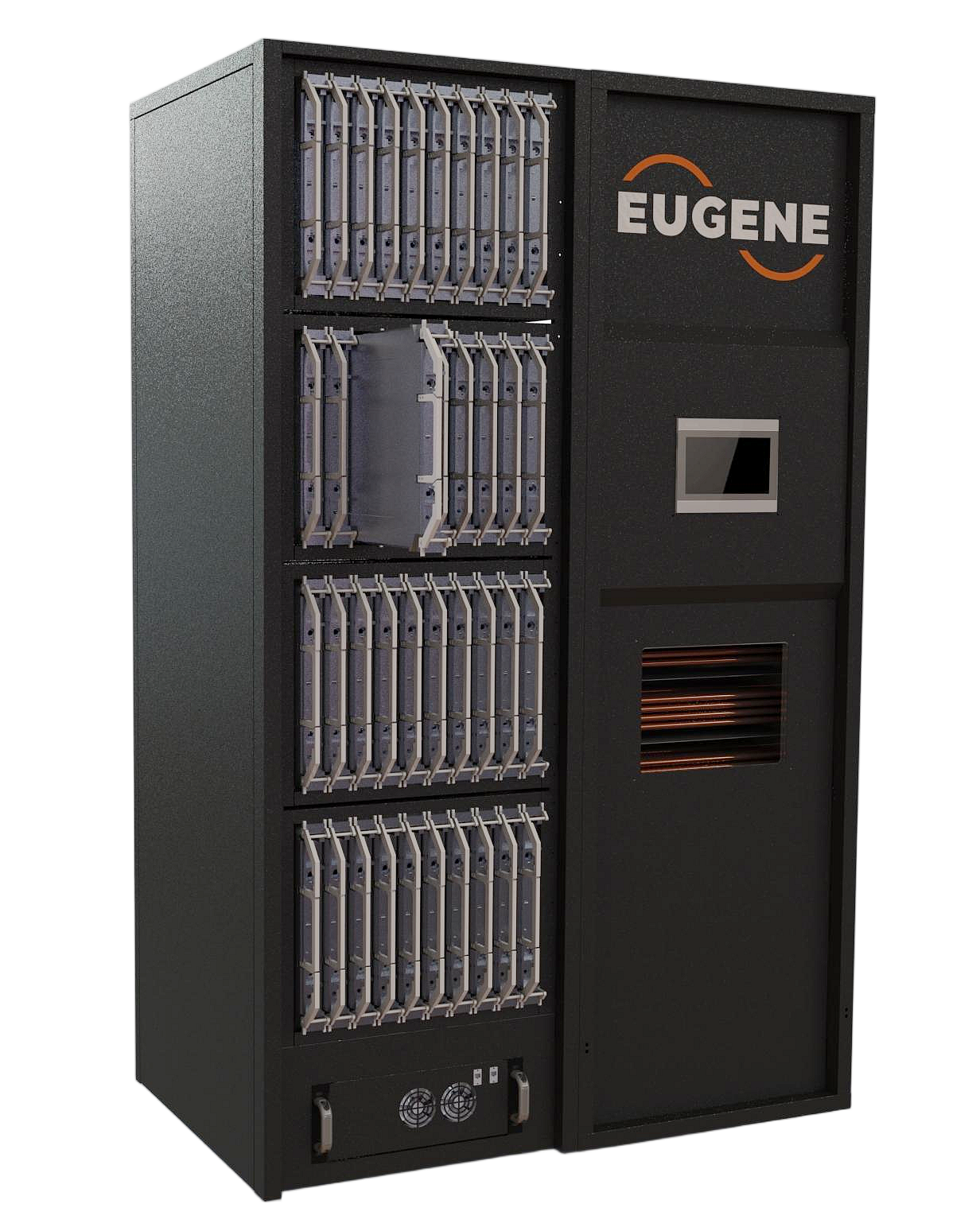
The Liquid Cooling Benchmark for the AI Era: A Thermal Revolution with 240kW Extreme Density and an mPUE of 1.01
Two-Phase Blade Immersion Cooling System
- Introduction
- As AI large-model training and high-performance computing (HPC) drive thermal challenges to new extremes, with single-chip power consumption surpassing 1200W, traditional air cooling has reached its limits. Eugene introduces the Modular Two-Phase Immersion Cooling System, which utilizes the latent heat of fluorinated fluids during phase change to deliver highly efficient heat transfer. Featuring a vertical blade chassis design, the system supports hot-swappable maintenance for individual units and achieves a rack power density of up to 240kW—double the industry standard. Through extreme energy efficiency management, the mPUE is driven down to 1.01, and space utilization is improved by 200%. This is the ultimate solution for building green data centers.
- Download
- This document includes the Technical White Paper on Modular Two-Phase Immersion Cooling Systems, detailing the system architecture, working principles, comprehensive advantages, and an economic analysis of the 10-year Total Cost of Ownership (TCO).
Extreme Sealing: Features a triple-seal design with an annual leakage rate of < 1.5%, significantly reducing coolant costs.
High Reliability: Equipped with a three-level leak detection mechanism, effectively reducing downtime by 50%.
Easy Maintenance: The modular design supports the hot-swapping of individual units without interrupting the operation of the entire rack.
Environmentally Friendly: Operating noise is kept below 60dB, and the system supports waste heat recovery and recycling.
Cooling Capacity: Rated at 240kW (10 blades per layer, 4 layers in total, amounting to 40 computing units).
Energy Efficiency: System power distribution consumption is only 1.7kW, with an mPUE ≈ 1.01.
Coolant Type: Low-boiling-point electronic-grade fluorinated fluid (boiling point approx. 47-49°C).
Power Architecture: 48VDC power supply, compatible with OCP standard busbars.
AI Clusters: Addresses the extreme cooling demands of 1000W+ single chips, ensuring stability for prolonged AI training sessions.
Edge Computing: The compact modular design is ideal for space-constrained environments that require rapid deployment.
HPC Centers: Meets the surging computing density requirements for scientific research and advanced simulations.
Google TPU Pods: Fully compatible with mandatory liquid-cooled architectures, such as TPU v7 (Ironwood).